What to Ask Before You Hire a Liquidator
By Doug Constable · 24 October 2026
Most directors pick a liquidator the same way they'd pick a plumber at 10pm on a Sunday. Whoever answers the phone first, sounds confident and says they can start Monday.
I understand why. By the time a company is heading for liquidation, the director is exhausted, the creditors are loud and the ATO letters have stopped being polite. But who you appoint matters more than almost any other decision you'll make in the whole process. And very few people ask the right questions before they sign.
You choose them. They don't work for you.
This is the part most directors don't understand until it's too late.
In a creditors' voluntary liquidation, the directors resolve that the company can't pay its debts, and the shareholders pass a special resolution to wind it up and appoint a liquidator. So yes, you pick the name on the form.
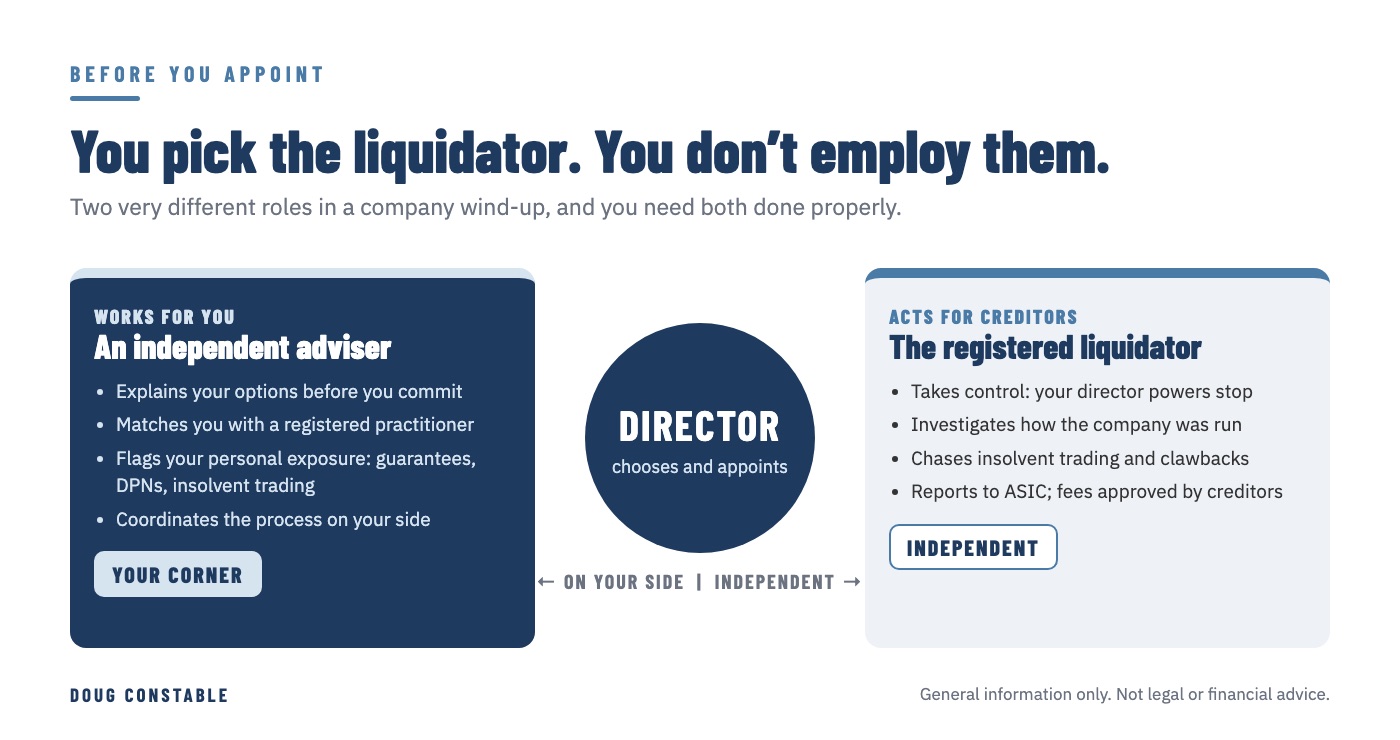
But the moment that liquidator is appointed, your powers as a director stop, and the liquidator's job is to act for the creditors as a whole. They are required to be independent. They will investigate how the company was run, look at whether it traded while insolvent, look for payments that can be clawed back, and report to ASIC. If the creditors don't like how it's going, they can vote to replace the liquidator with someone else.
None of that is a criticism. That's exactly how the system is meant to work, and a good liquidator does it well. The problem is the director who walks in thinking the liquidator is "their" person. They're not, and they shouldn't be.
The questions I'd ask before signing anything
1. Are you a registered liquidator? Only a registered liquidator can be appointed to wind up a company. ASIC keeps a public register of them. Check the name yourself. It takes two minutes.
2. Will you give me your DIRRI up front? That's the Declaration of Independence, Relevant Relationships and Indemnities. Every liquidator has to give one to creditors. It sets out any dealings they've had with the company, its directors or its advisers in the last two years, who referred the job, and whether anyone has given them an indemnity or paid money up front. Read it before you appoint, not after.
3. How are your fees worked out, and what's your estimate? Liquidators usually charge on time, at hourly rates set by staff level. Ask for the rates, a realistic estimate of the total, and what happens if there's little or no money in the company. Creditors, a committee of inspection or the court have to approve the fees. If they don't, the liquidator is limited to a capped default amount. In a creditors' voluntary liquidation, the liquidator must send creditors an initial notice of how fees will be charged within 10 business days of the winding-up meeting.
4. Who's paying, and is anyone indemnifying you? If the company has no assets, someone often has to fund the start of the job, and that's frequently the director. That's normal, but it must be disclosed in the DIRRI, and it doesn't buy you any favours.
5. What will you investigate, and what should I expect? A good liquidator will tell you straight: they'll look at insolvent trading, payments to related parties, payments to creditors in the months before the appointment, and the state of the books. Better to hear it from them on day one than be blindsided in month three.
6. What does this mean for me personally? Liquidation ends the company. It doesn't end your exposure. A personal guarantee you signed to a landlord, bank or supplier stays alive. A director penalty notice may already have locked you in for unpaid PAYG and super. An insolvent trading claim lands on you, not the company. Ask the liquidator to walk you through where you stand, and get independent help on the parts that are yours to deal with.
7. Who will I actually deal with? The partner you meet may hand the file to a junior the next day. Ask who your day-to-day contact is and how fast they answer the phone.
8. How long, and what do you need from me? Ask what records they'll need, by when, and roughly how long the job will run. A director who hands over complete books early makes everything faster and cheaper.
Who works for you?
Here's where I come in, and why I do what I do.
I'm not a liquidator and I don't act for creditors. I work for the director. My job is to sit on your side of the table, help you understand your options before you commit to one, match you with a registered practitioner who suits the matter, and coordinate the process so you're not working it out alone at the worst moment of your working life.
The liquidator does their job independently. I make sure the director understands what's happening, what's expected of them and where their personal risks are. Those are two different roles, and you need both to be done properly.
The red flags: walk away
There's another kind of "adviser" out there, and ASIC has been warning directors about them for years. The pre-insolvency industry is unregulated. Anyone can call themselves a business rescue expert. Most are honest. Some are not.
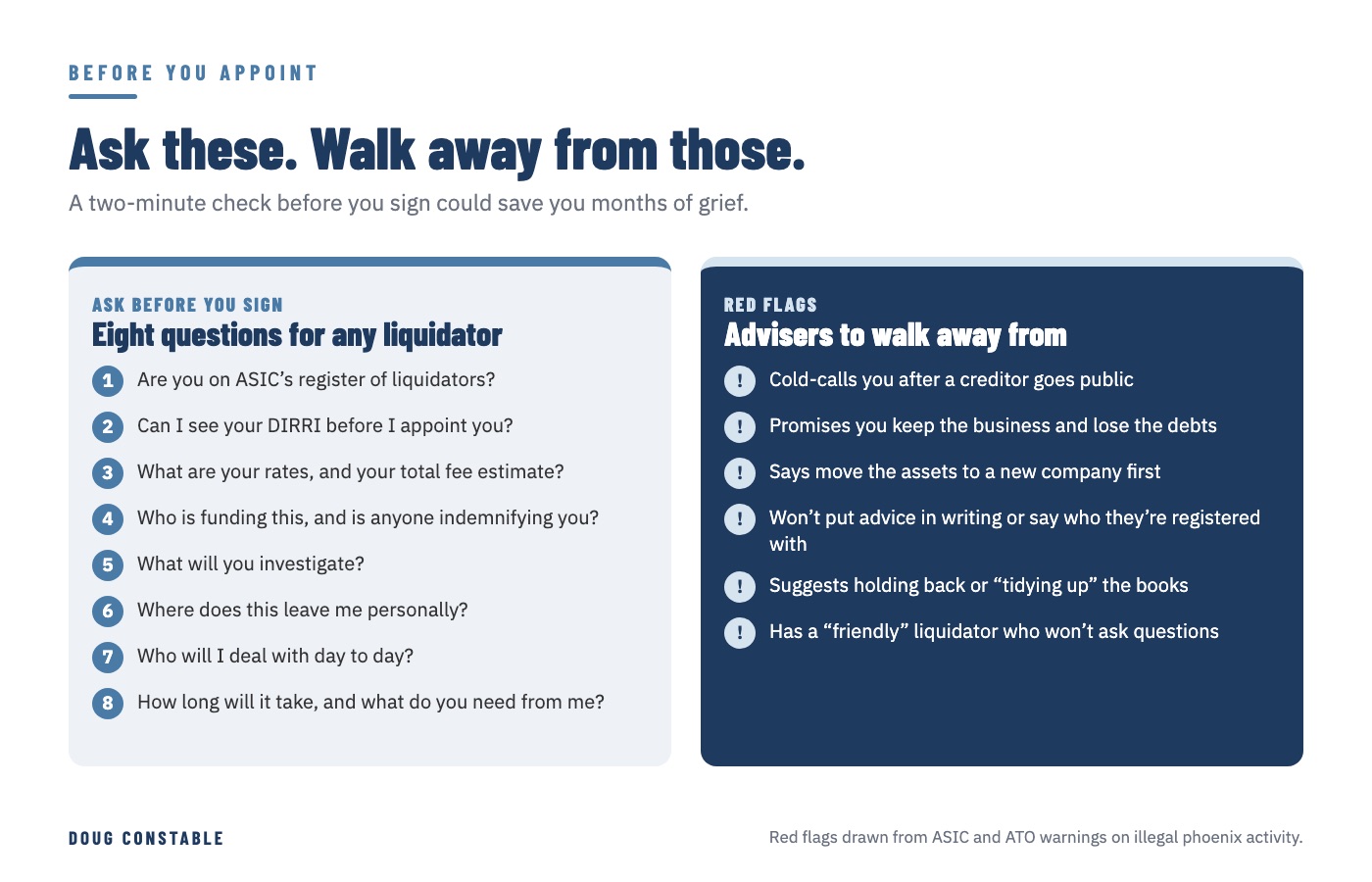
Be very wary if someone:
- Cold-calls you after a winding-up application or a creditor's demand has gone public.
- Promises you can keep the business and walk away from all the debts.
- Tells you to move the assets, the customers or the website into a new company before anything else happens.
- Won't put their advice in writing, or won't tell you who they are registered with.
- Suggests you hold back, lose or "tidy up" the company's books before the liquidator gets them.
- Already has a "friendly" liquidator lined up who won't ask too many questions.
That's not restructuring. That's the road to illegal phoenix activity, and ASIC is clear that advisers who help a director do it can face the same penalties as the director. The director, though, is still the one in the firing line. If you're not sure whether advice you've been given is legitimate, the ATO and ASIC both take reports.
The short version
Choose your liquidator with your eyes open. Check the register. Read the DIRRI. Get the fee estimate in writing. Ask what they'll investigate and what it means for you personally. And understand from day one that they work for the creditors, not for you.
If you'd like someone in your corner who does work for you, that's the conversation I have every day.
- Speak directly to Doug: Get help
- Business recovery, SBR and liquidation: Resolve Business Solutions
- Independent bankruptcy help: Resolvency
- Read more insights
This article is general information only. Resolve Business Solutions coordinates and liaises on insolvency matters; it does not provide legal or financial advice and is not a registered liquidator.
No robes. No wigs. Just results.