The System Is the Solution: Why Every Problem Lands on Your Desk
By Doug Constable · 23 October 2026
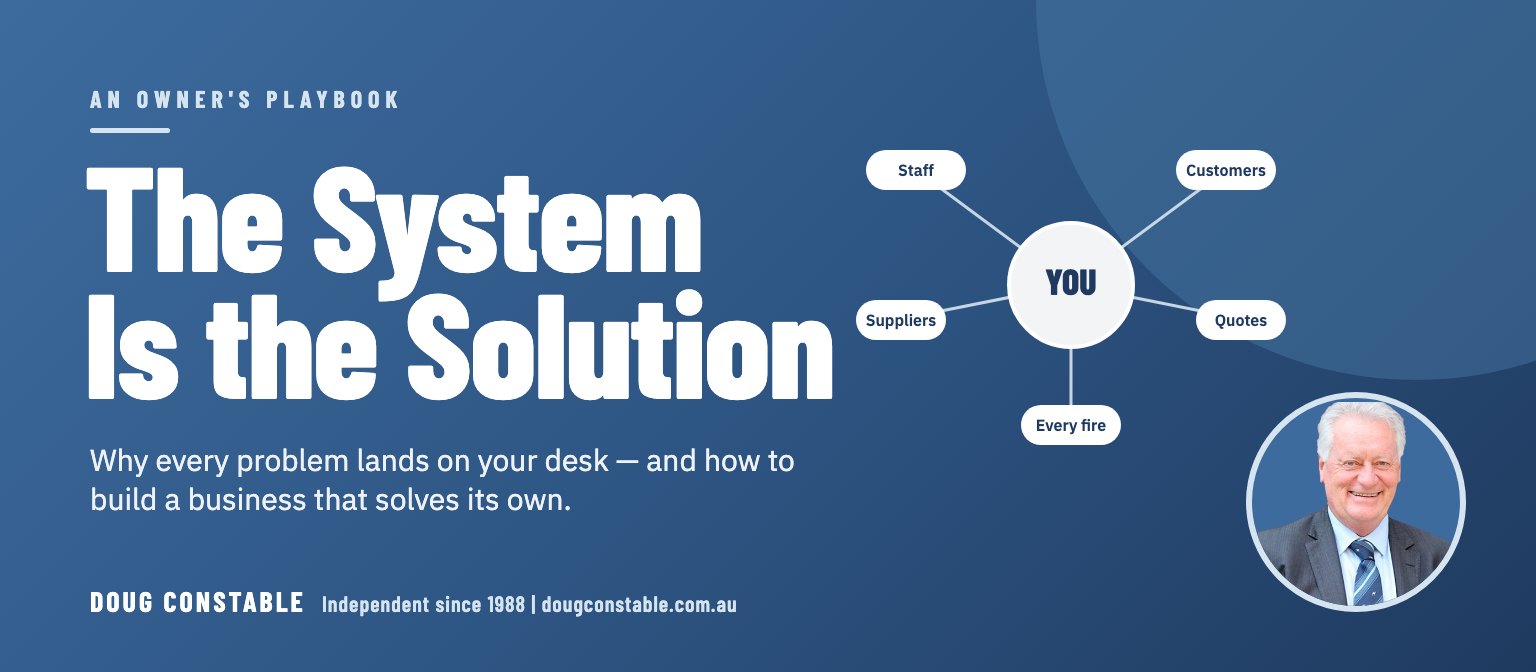
Here's a question I ask every business owner who sits down with me: if you went away for four weeks, what would happen to the business?
Most of them laugh. Then they go quiet. Because the honest answer is that it would grind to a halt. Staff would be waiting on decisions. Customers would be asking for them by name. The quotes wouldn't go out and nobody else knows where the numbers stand.
That isn't a business. That's a job, with the owner as the boss, the best worker, the help desk and the night shift.
I know, because in 1988 that was me. I did everything, I solved every problem anyone brought to me, and I lost the business. I've spent the 38 years since helping owners build businesses that don't depend on them for every answer. I've put the lessons into a short playbook, The System Is the Solution, built on Michael Gerber's The E-Myth Revisited and what I've seen across hundreds of small and medium businesses. Here's the short version, and a link to the full thing below.
Why every problem finds you
Gerber's insight is that most businesses aren't started by entrepreneurs. They're started by technicians: the tradie, the bookkeeper, the chef, the designer. People who are very good at the work, who one day decide they could do it themselves.
The trap is believing that if you understand the work, you understand a business that does the work. They're two different jobs. And because you're the best technician in the building, every hard question goes to the person who can answer it fastest. You.
Gerber says every owner is three people at once: the Entrepreneur who looks ahead, the Manager who wants order, and the Technician who wants to get on with the job. In most owners, the Technician is running about 70 per cent of the show. So when a staff member walks in with a problem, the Technician grabs it and fixes it. Nobody asks why it keeps happening, or why it reached the owner at all.
What it really costs
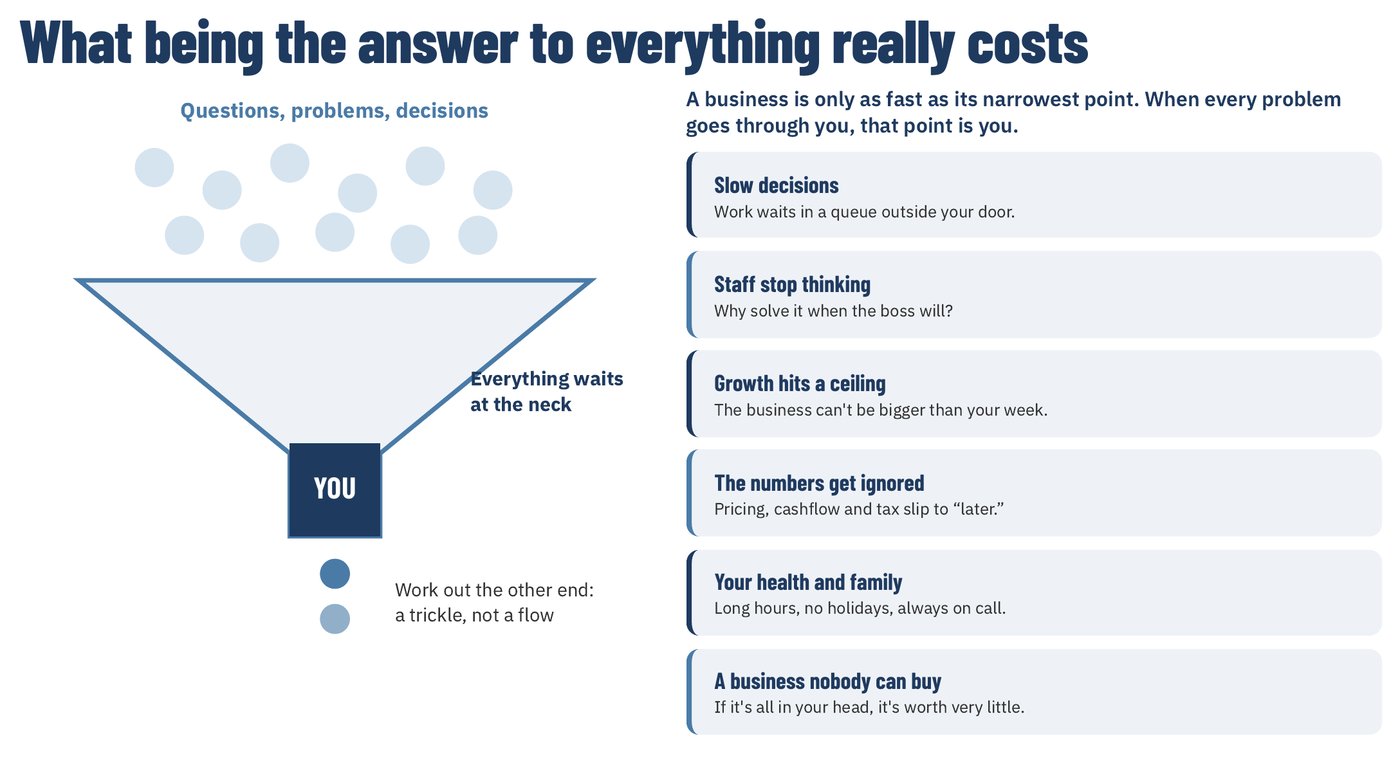
A business is only as fast as its narrowest point. When everything goes through you, that point is you. Decisions queue outside your door. Staff stop thinking, because why solve it when the boss will? Growth stops at the edge of your working week. The numbers, the pricing and the planning get pushed to nights and weekends, or never. And you end up with a business nobody can buy, because it all lives in your head.
There's a loop that keeps owners stuck here. You hand a job over with no system and no standard. It goes wrong. You take it back and tell yourself it's quicker to do it yourself. Gerber calls it management by abdication, and every lap teaches you that only you can do it.
The system is the solution
Gerber's test is simple: build the business as though you're going to sell it, or as though you'll have to open 5,000 more just like it. McDonald's real product was never the burger. It was the system that turns out the same burger every time, run by ordinary people.
You don't need to franchise to use that idea. You need to accept one thing: every problem that keeps reaching you is a missing system. Systems run the business. People run the systems. Your job is to design them.
Route problems, don't absorb them
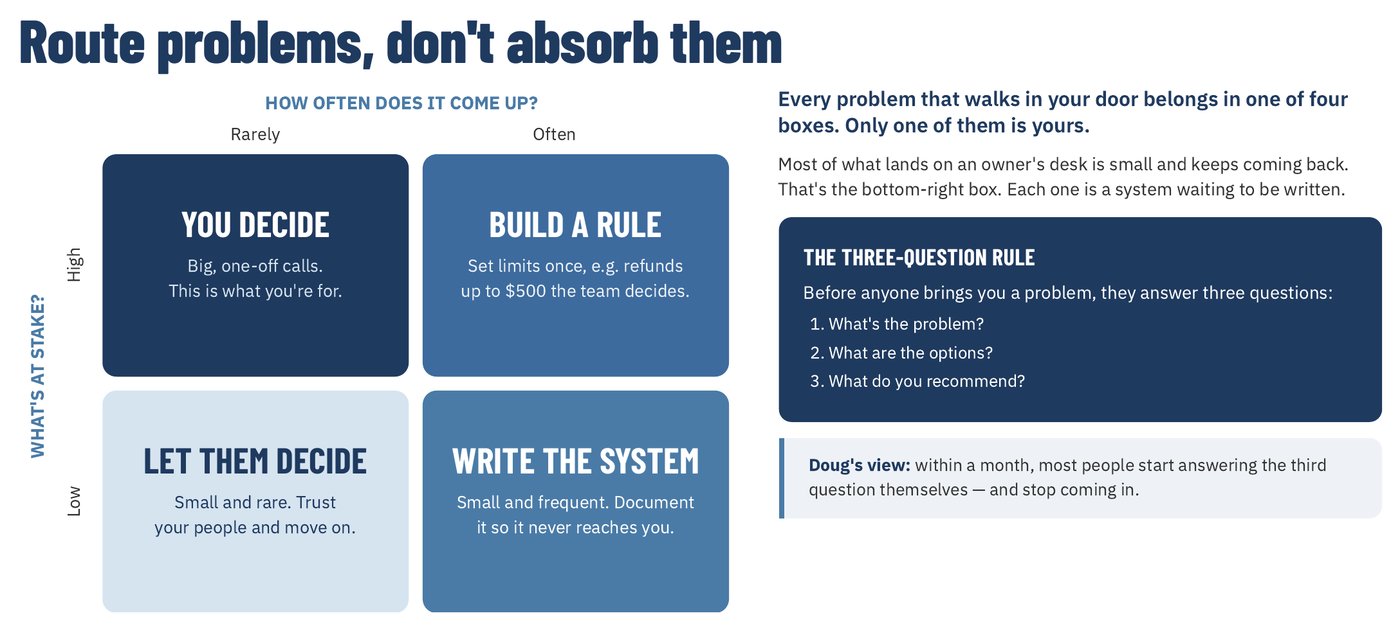
Every problem that walks in your door fits one of four boxes, depending on how often it comes up and how much is at stake. Big one-off calls are yours. That's what you're for. Big calls that keep coming back need a rule, like letting the team approve refunds up to a set amount. Small, rare problems, let your people decide. And the small, frequent ones, which are most of what lands on an owner's desk, need a written system so they never reach you again.
Then add one rule. Before anyone brings you a problem, they answer three questions: What's the problem? What are the options? What do you recommend? In my experience, within a month most people start answering the third question themselves, and stop coming in.
Start this month
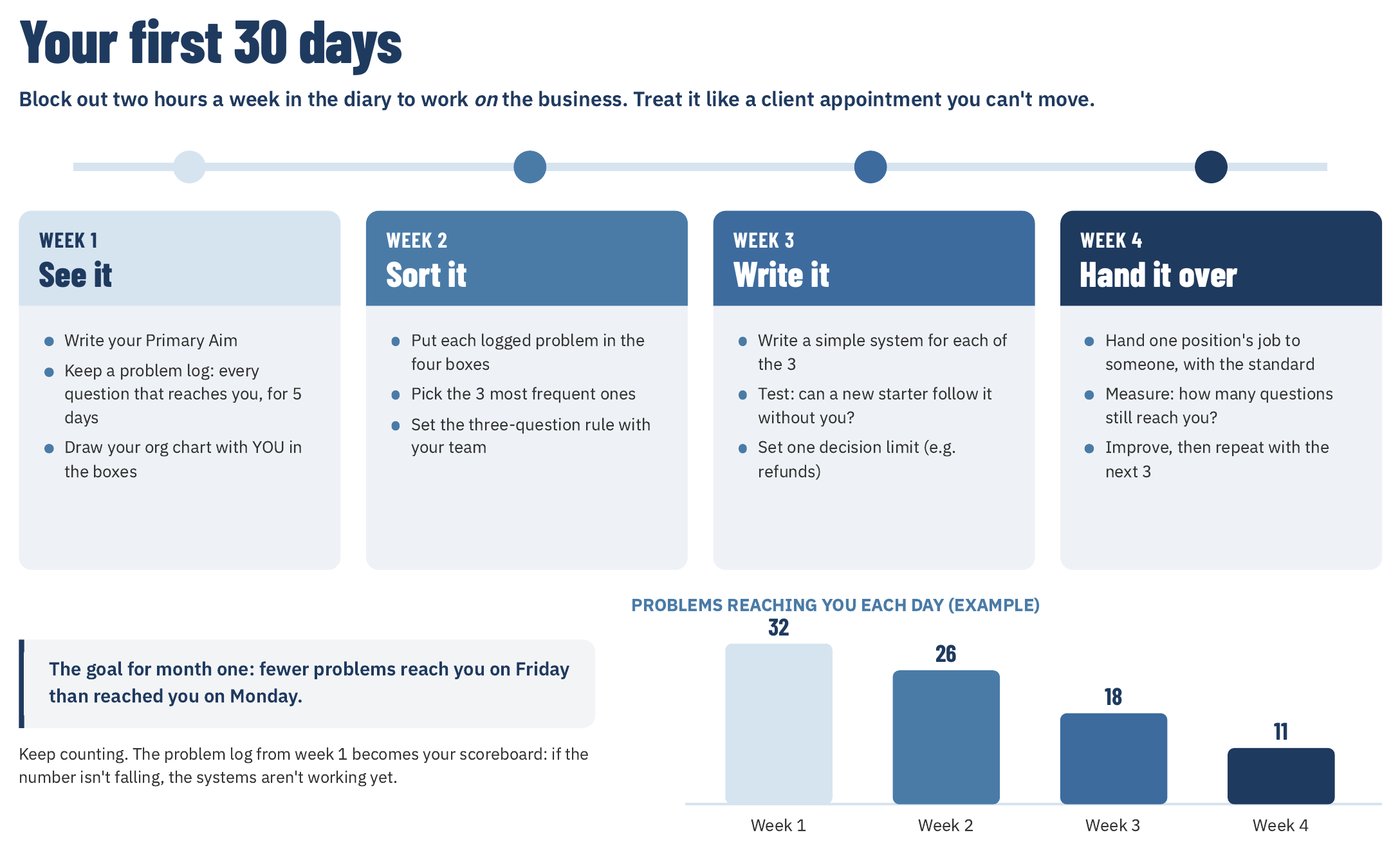
Block out two hours a week to work on the business, not in it, and treat it like a client appointment you can't move. Week one, log every problem that reaches you for five days. Week two, sort them into the four boxes and pick the three that come up most. Week three, write a simple system for each and test whether a new starter could follow it. Week four, hand one over with a clear standard, and count how many questions still reach you.
The goal for month one is simple: fewer problems reach you on Friday than reached you on Monday.
The full playbook covers all of this in more depth, including Gerber's seven steps, how to draw your business as positions rather than people, and a self-check to see how much of a bottleneck you've become.
Download The System Is the Solution, the full playbook (PDF)
- Speak directly to Doug: Get help
- Business advisory and growth: Resolve Business Solutions
- Independent bankruptcy help: Resolvency
- Read more insights
This article and playbook summarise and comment on ideas from The E-Myth Revisited by Michael E. Gerber. They are independent of, and not endorsed by, the author or publisher. I recommend reading the book.
No robes. No wigs. Just results.