Will I Lose My House If I Go Bankrupt?
By Doug Constable · 24 October 2026
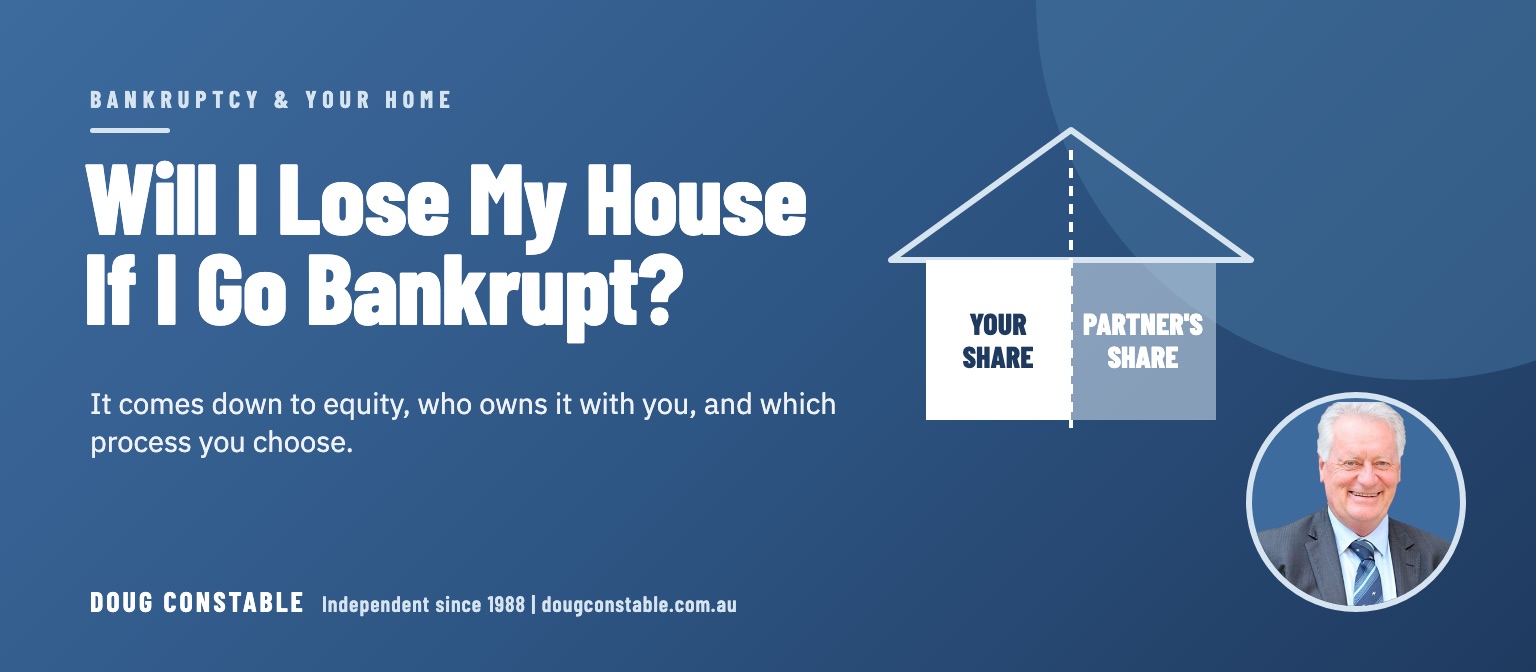
It's the first question almost everyone asks me, usually before they've asked anything about their debts. Will I lose the house?
The honest answer is: it depends on one number, and it isn't the one most people think. It's not what you owe. It's how much equity you have, and who owns it with you.
The day you go bankrupt, your share of the house changes hands
When you become bankrupt, your trustee (AFSA's Official Trustee or a registered private trustee) becomes the legal owner of your share of any property you own. Not the bank. Not your creditors. The trustee. From that day you can't sell it, refinance it or deal with it yourself, and the trustee will usually lodge a caveat on the title or have it transferred into their name.
What the trustee then does depends on whether selling your share would put real money in front of your creditors.
Equity is the number that matters
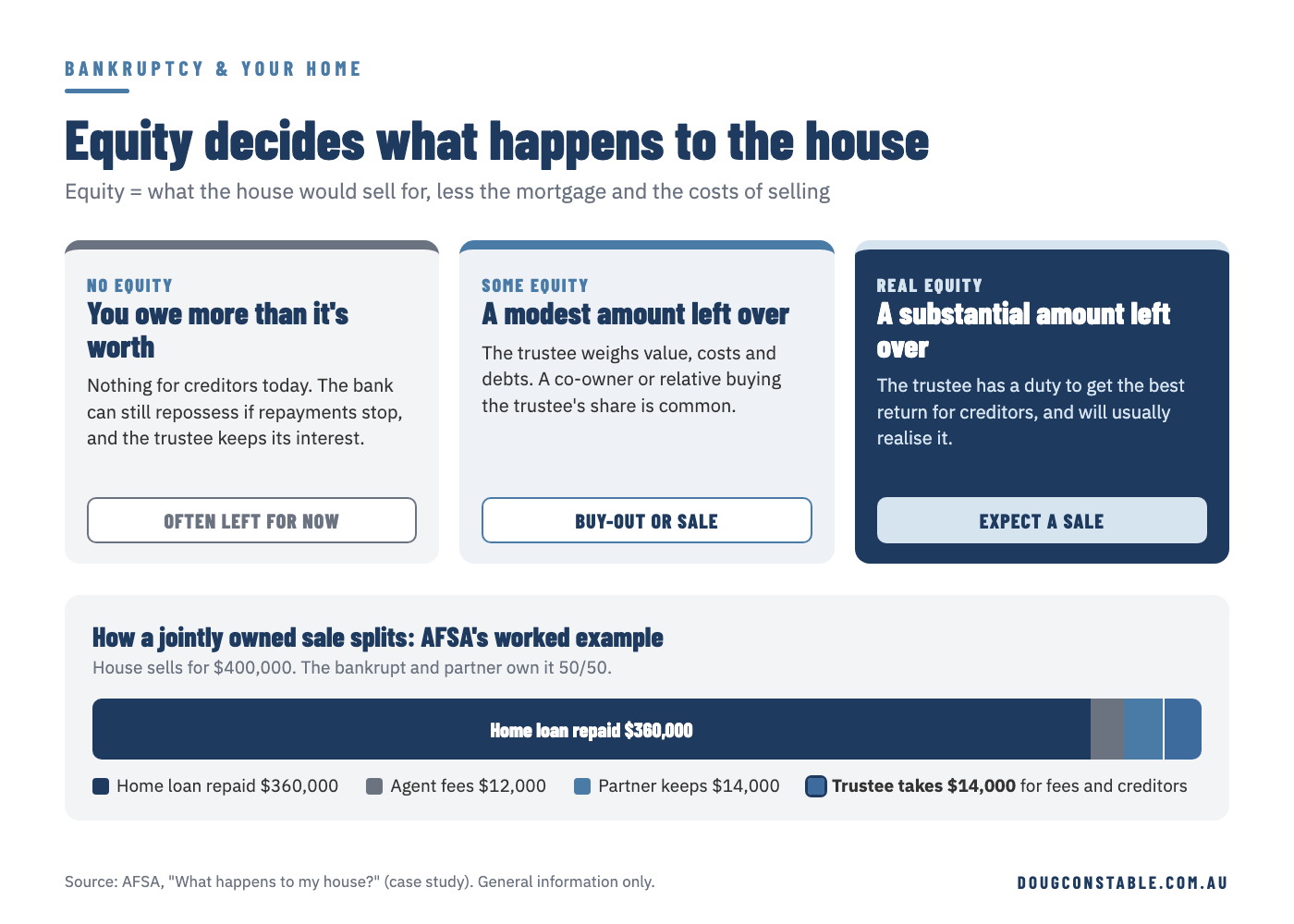
No equity. If the house is worth $320,000 and you owe the bank $400,000, there's nothing for creditors. The trustee may leave it alone for now. But two things still hold. The mortgage is a secured debt, so if you stop paying, the bank can repossess no matter what the trustee decides. And the trustee keeps its interest, which matters later.
Some equity. This is where most families sit, and where the real decisions happen. The trustee weighs the value, the costs of selling and what creditors are owed. A modest amount of equity in a jointly owned home often ends with someone buying out the trustee's interest rather than a sale.
Real equity. If there's a substantial amount left after the mortgage and selling costs, expect the trustee to realise it. That's their job. They have a legal duty to get the best return for creditors.
If you own it with your partner
Your partner's share is theirs. The trustee only takes yours. But your partner can't sell, refinance or deal with the property without the trustee's consent either, so their life gets tied up in your bankruptcy whether they like it or not.
The usual options are:
- Your partner buys the trustee's share. The offer has to reflect what the trustee would get on the open market. A token offer gets knocked back.
- Someone else buys it. A relative or friend can buy the trustee's share.
- The house is sold. The loan and selling costs come out first, and what's left is split by ownership share.
If nobody can agree, the trustee can go to court for an order to sell. And if the house is in your partner's name only, don't assume that ends it. A trustee can look at whether you have a financial interest in it anyway, for example if you live there and pay the mortgage.
It doesn't end when your bankruptcy ends
This is the part that catches people. Bankruptcy normally lasts three years, but the trustee's interest in your house doesn't disappear on discharge. Trustees go back and recalculate equity. If you've paid the mortgage down or the market has lifted, there can suddenly be value worth selling, years after you thought it was over.
There's a time limit, generally six years from discharge, with some variations. So a house with no equity today can become a problem four or five years from now. Going in with your eyes open on this is far better than finding out from a letter.
What you get to keep
Bankruptcy is not the trustee arriving with a truck. You keep:
- Ordinary household items of reasonable value: furniture, appliances, the things a family needs.
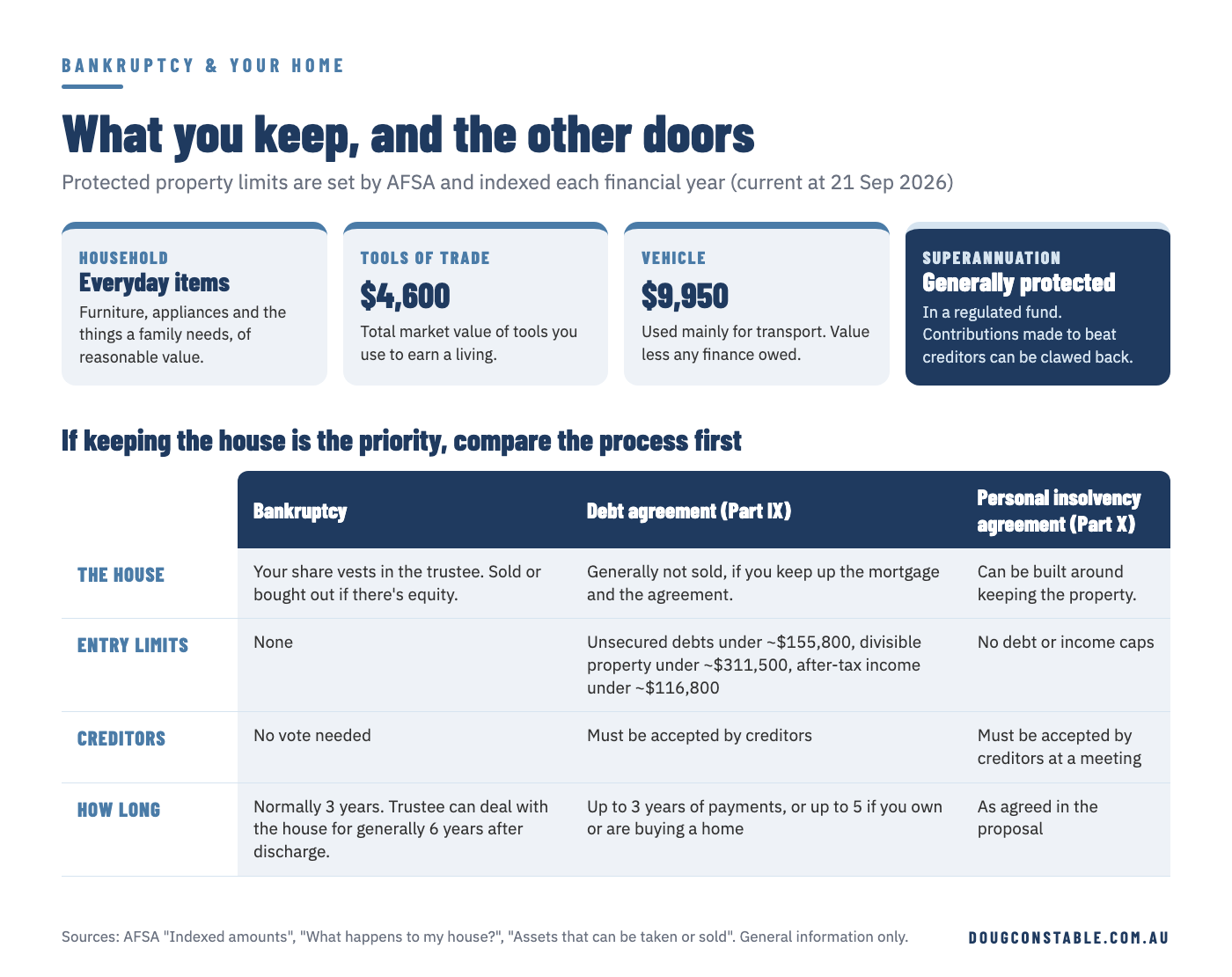
- Tools of trade up to $4,600 in current market value.
- A vehicle used mainly for transport up to $9,950, counted as its value less any finance owed.
- Superannuation in a regulated fund, generally, unless contributions were made to get money out of creditors' reach.
Those dollar limits are set by AFSA and indexed every financial year.
Bankruptcy isn't the only door
If keeping the home is the priority, bankruptcy may be the wrong tool. A debt agreement under Part IX of the Bankruptcy Act lets you pay creditors an agreed amount over time, and the house is generally not sold, as long as you keep up the mortgage and the agreement. There are entry limits: currently unsecured debts under about $155,800, divisible property under about $311,500 and after-tax income under about $116,800. A personal insolvency agreement under Part X has no such caps and can be built around keeping a property, but it needs creditors to vote it through.
Neither is free of consequences. Both affect your credit and both have to be workable. But for a family with equity in the home, the choice of process is often the difference between keeping it and losing it.
What I tell people
Don't make the decision in a panic at 2am, and don't let anyone rush you into lodging a bankruptcy application before someone has looked at the house, who's on the title and what the equity really is. That one conversation decides more than anything else.
In 38 years I've seen plenty of families keep their homes through a financial collapse. Almost always it's because they got proper advice early, picked the right process and dealt with the house first, not last.
- Speak directly to Doug: Get help
- Independent bankruptcy help: Resolvency
- Business recovery, SBR and liquidation: Resolve Business Solutions
- Read more insights
This article is general information only. It is not legal or financial advice. Thresholds change each financial year; get advice on your own circumstances from a registered trustee or lawyer.
No robes. No wigs. Just results.