The ATO Froze My Bank Account. Now What?
By Doug Constable · 24 October 2026
The call usually comes on a Tuesday morning. Wages are due Thursday, the account should have $40,000 in it, and the owner has logged in to find it sitting at zero. No warning from the bank. No court order. The money has gone to the ATO.
That's a garnishee notice. And right now the ATO is using them more than it has in years.
What a garnishee notice actually is
Under section 260-5 of Schedule 1 to the Taxation Administration Act 1953, the ATO can direct a third party that holds money for you, or owes money to you, to pay it to the ATO instead. No court is involved. The third party has to comply, and if it ignores the notice it commits an offence and becomes liable for the amount itself. So banks don't argue. They pay.
Most people think "bank account" when they hear the word, but the notice can go to anyone in your money chain:
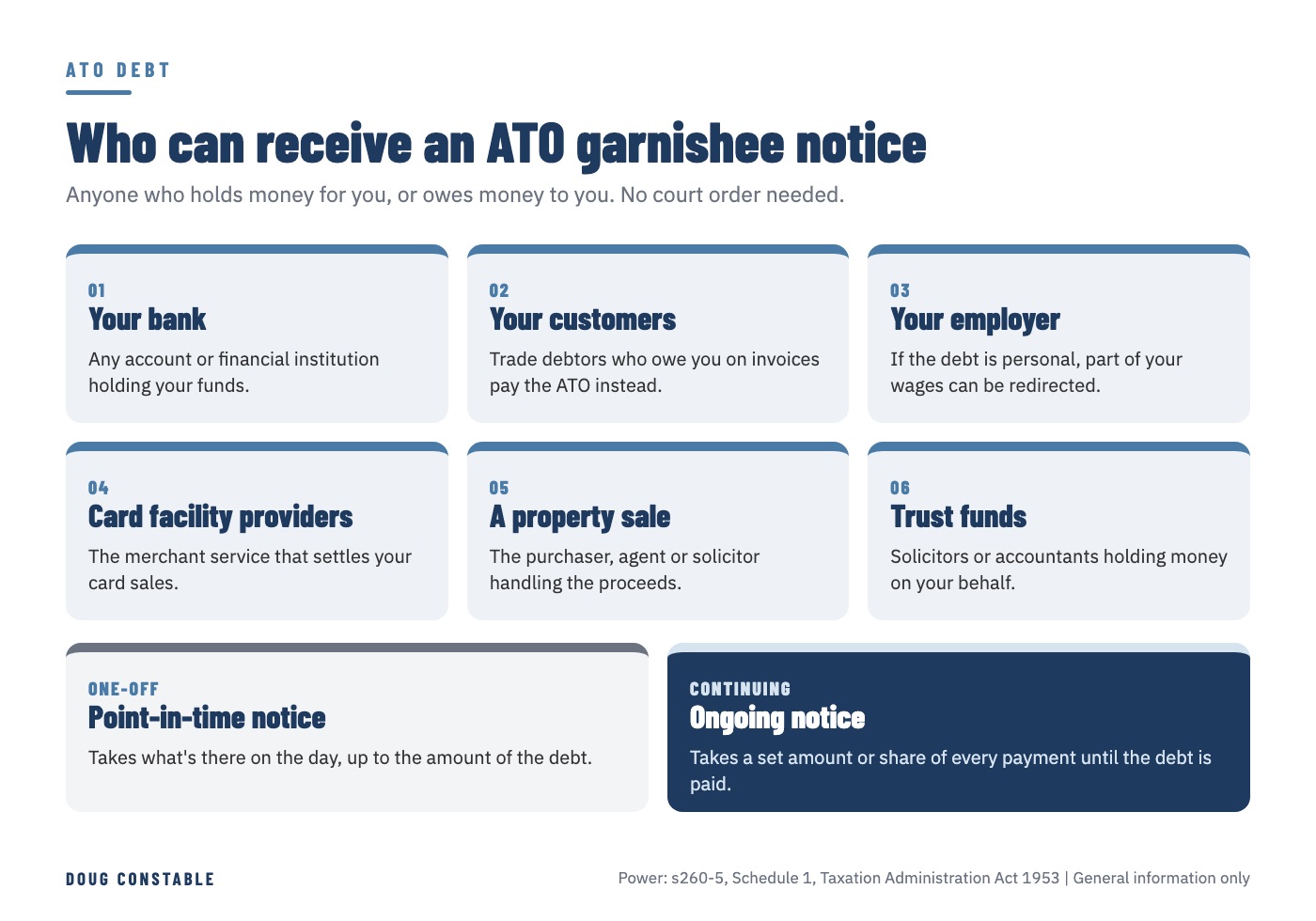
- Your bank or any financial institution holding your funds
- Your customers who owe you on invoices
- Your employer, if you're the debtor personally
- Merchant card facility providers that settle your card sales
- People involved in a property sale: the purchaser, the agent, the solicitor
- Solicitors or accountants holding money for you in trust
A notice can be a one-off, taking whatever is there on the day up to the amount of the debt. Or it can be continuing, taking a set amount or percentage of every payment that comes through until the debt is cleared. The continuing kind, sent to your biggest customer, can quietly strangle a business for months.
It rarely comes out of the blue
The bank doesn't warn you, but the ATO usually has. By the time a garnishee lands there have normally been statements, reminder letters, phone calls and a letter warning that firmer action is coming. In my experience most owners who get hit had those letters sitting unopened in a pile, or opened and put aside because there was no money to deal with them.
The ATO has been very clear about who it's targeting. In FY2024-25 it issued more than 15,000 garnishee notices and over 84,000 Director Penalty Notices, up from about 26,700 DPNs the year before. Small business now owes it around $35.9 billion in collectable debt. Its own words: businesses that don't engage or set up a payment plan, especially on GST, PAYG withholding and super, can expect it to move more quickly to firmer action.
Read that carefully. The trigger isn't the size of the debt. It's silence.
What it does to a business
A garnishee doesn't only take the tax money. It takes the wages money, the supplier money and the rent money, because it's all in the same account. Staff don't get paid on Thursday. Suppliers put you on stop. If the notice went to a customer, that customer now knows you have a tax problem, and so does anyone they talk to.
I've seen viable businesses fold within weeks of a garnishee, not because the tax debt was unmanageable, but because the cash shock arrived with no plan in place.
What to do in the first seven days
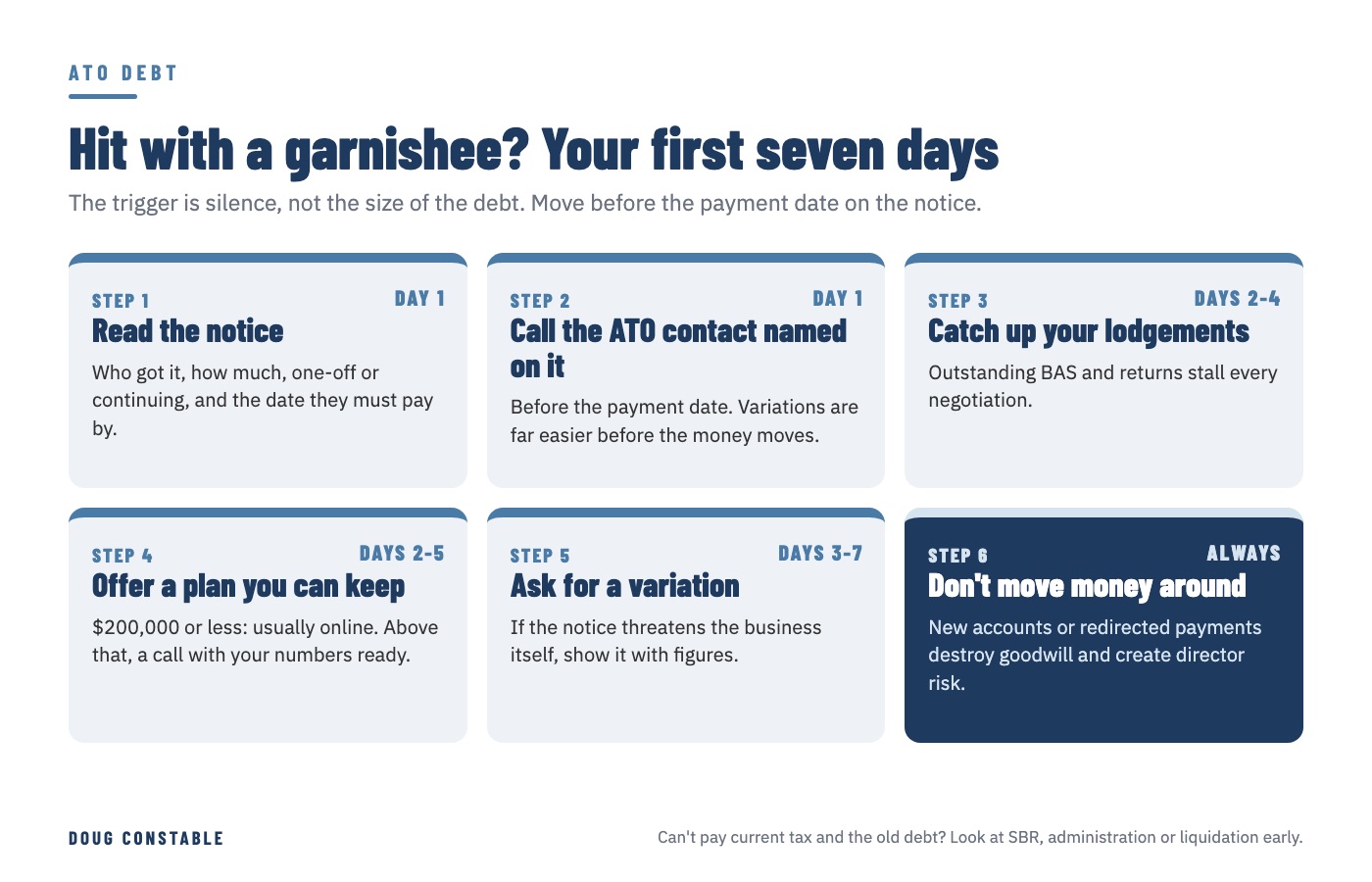
1. Read the notice properly. Who received it, how much, one-off or continuing, and the date the third party must pay by. Your copy names an ATO contact. That person matters.
2. Call the ATO before the payment date. Not your accountant first, not next week. The ATO can vary or withdraw a notice where you put forward suitable alternative arrangements, and it's far easier before the money moves than after.
3. Get your lodgements up to date. The ATO won't negotiate seriously with a business that has outstanding BAS or returns. If you can't calculate the debt, neither can they.
4. Put a realistic payment plan on the table. Businesses owing $200,000 or less can usually set one up online through Online services for business. Above that, it's a phone call and a conversation about your income, expenses, bank balances and assets. Offer what you can actually pay. A plan that defaults in month two makes the next conversation much harder.
5. Ask for a variation if the notice threatens the business itself. The ATO's own practice statement says it weighs your financial position, your other debts and whether the notice would stop you providing for your family or keep the business viable. If a continuing notice is taking more than the business can survive on, say so, with numbers.
6. Don't start moving money around. Opening a new account, routing customer payments elsewhere or emptying the account the day before a known payment date looks like exactly what it is. It destroys any goodwill you had with the ATO and can create much bigger problems for a director down the track.
When a garnishee is telling you something bigger
Sometimes a payment plan fixes it. The business had a bad quarter, the debt is manageable, and once the ATO sees a credible plan the pressure comes off.
But a garnishee is often the first visible sign that the debt has outgrown the business. If you can't keep current BAS and super up to date and pay off the old debt at the same time, a payment plan only delays the next notice. That's the point to stop negotiating month by month and look at the real options: a Small Business Restructuring, a voluntary administration, or a controlled liquidation that protects you as a director.
One thing owners often get wrong: calling in a liquidator later doesn't automatically undo a garnishee. The ATO doesn't ordinarily withdraw a notice just because the company enters insolvency. Timing matters, and the earlier you get proper help, the more options stay on the table.
I lost my own business in 1988. I know what it is to open the account and see nothing there. The owners who come through it are the ones who pick up the phone in the first week, not the ones who wait to see what happens next.
- Speak directly to Doug: Get help
- Business recovery, SBR and liquidation: Resolve Business Solutions
- Independent bankruptcy help: Resolvency
- Read more insights
This article is general information only and isn't legal, tax or financial advice. Every ATO debt is different, so get help with your own situation.
No robes. No wigs. Just results.