Will My Partner Be Dragged Into My Bankruptcy?
By Doug Constable · 24 October 2026
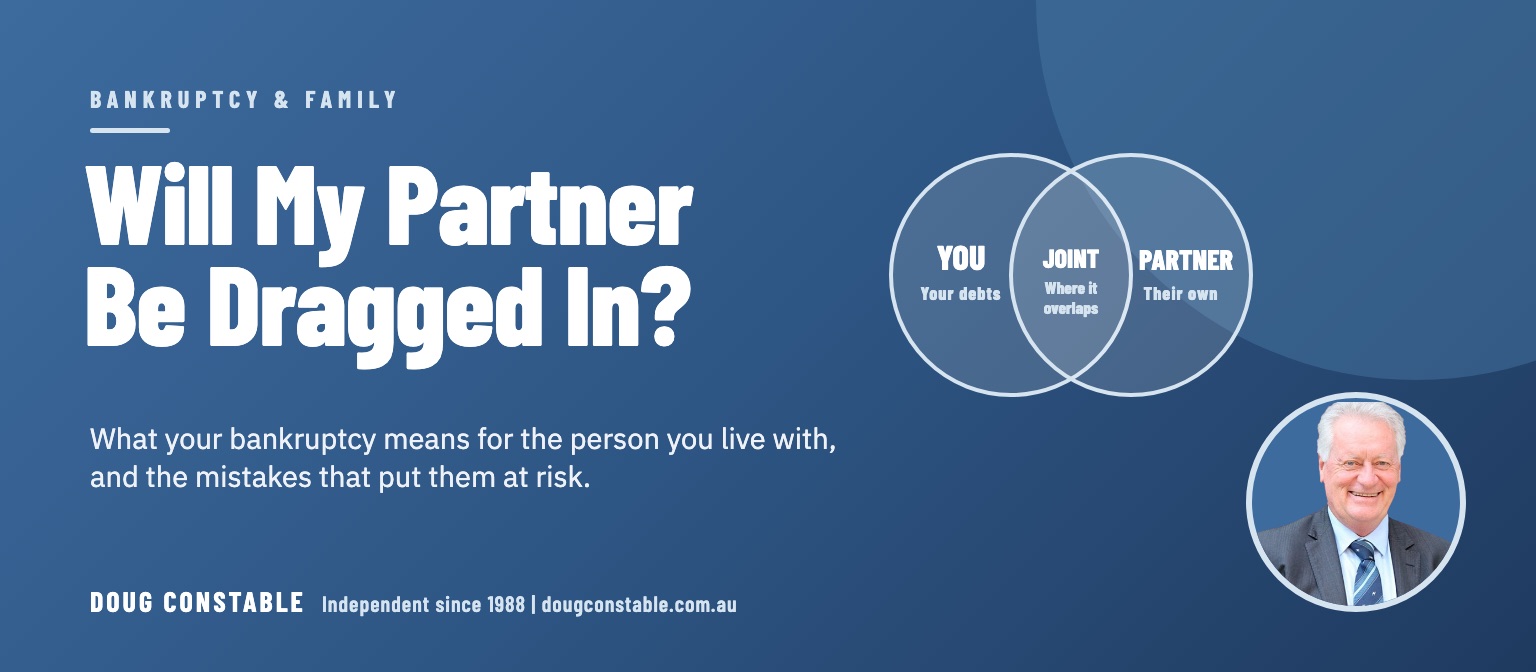
Your partner does not go bankrupt because you do. Bankruptcy is personal. It attaches to you, your debts and your assets, not to the person you live with. But in 38 years of sitting across the table from couples, I've learned that "it's only me" is where the misunderstandings start. The money in a household is rarely as separate as people think, and the parts that overlap are exactly where a partner gets caught.
Here's how it actually works, and where the traps are.
What stays with you
Debts in your name alone stay yours. If you signed the business loan, the credit card or the supplier account on your own, your creditors can't chase your partner for it. Your bankruptcy also sits on your credit file and on the National Personal Insolvency Index, not theirs.
Your partner's own wages, savings and assets in their sole name are theirs. The trustee has no claim on them simply because you're married or living together.
Where it reaches your partner
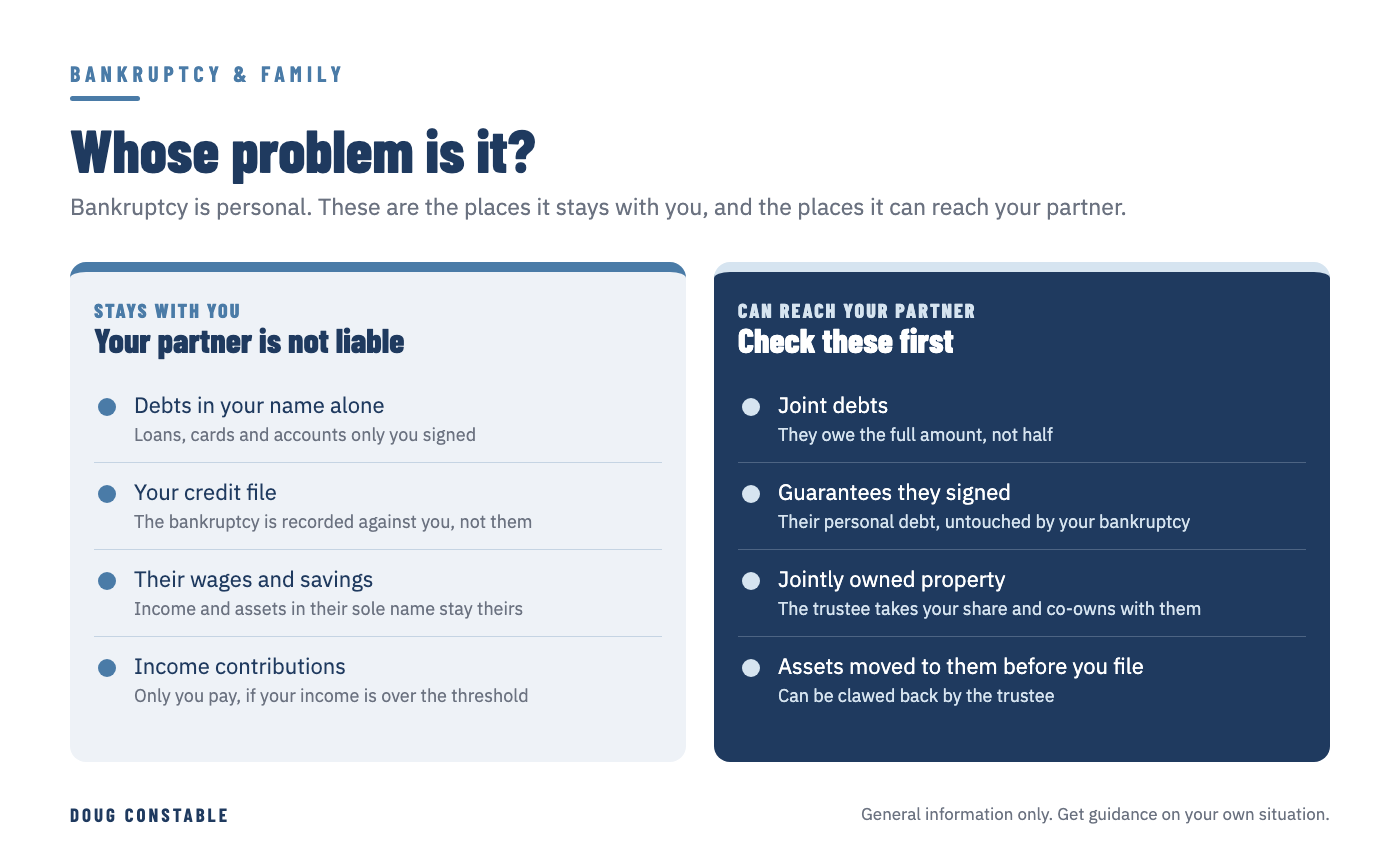
Joint debts. If you both signed, you're each liable for the whole amount, not half. When you go bankrupt, the creditor can't keep chasing you, so they turn to the one person still on the hook. I've seen partners blindsided by a joint credit card or a car loan they'd forgotten they co-signed.
Guarantees they signed. This is the big one for business owners. Banks routinely ask for a spouse's guarantee on business finance. If your partner signed one, that guarantee is their personal debt, and your bankruptcy doesn't touch it. Dig out the paperwork before anything else.
Jointly owned property. Your share of the family home, or anything else you own together, passes to the trustee. Your partner's share stays theirs. In practice, the trustee becomes your partner's co-owner, and the usual options are that your partner buys out your share, it's sold to someone known to the family, or the property goes on the market. That's a conversation to have early, with a plan, not after a letter arrives.
Joint bank accounts. Your share of the money in a joint account can be claimed. Households that run everything through one account get a nasty surprise here. Get the household finances sorted properly and transparently before you file, with proper guidance. Moving money the wrong way creates a bigger problem, which brings me to the next point.
Don't move the house into their name
This is the most common instinct I see, and it's the one that does the most damage. Someone senses bankruptcy coming and transfers their half of the house, the car or the savings to their partner, "to keep it in the family."
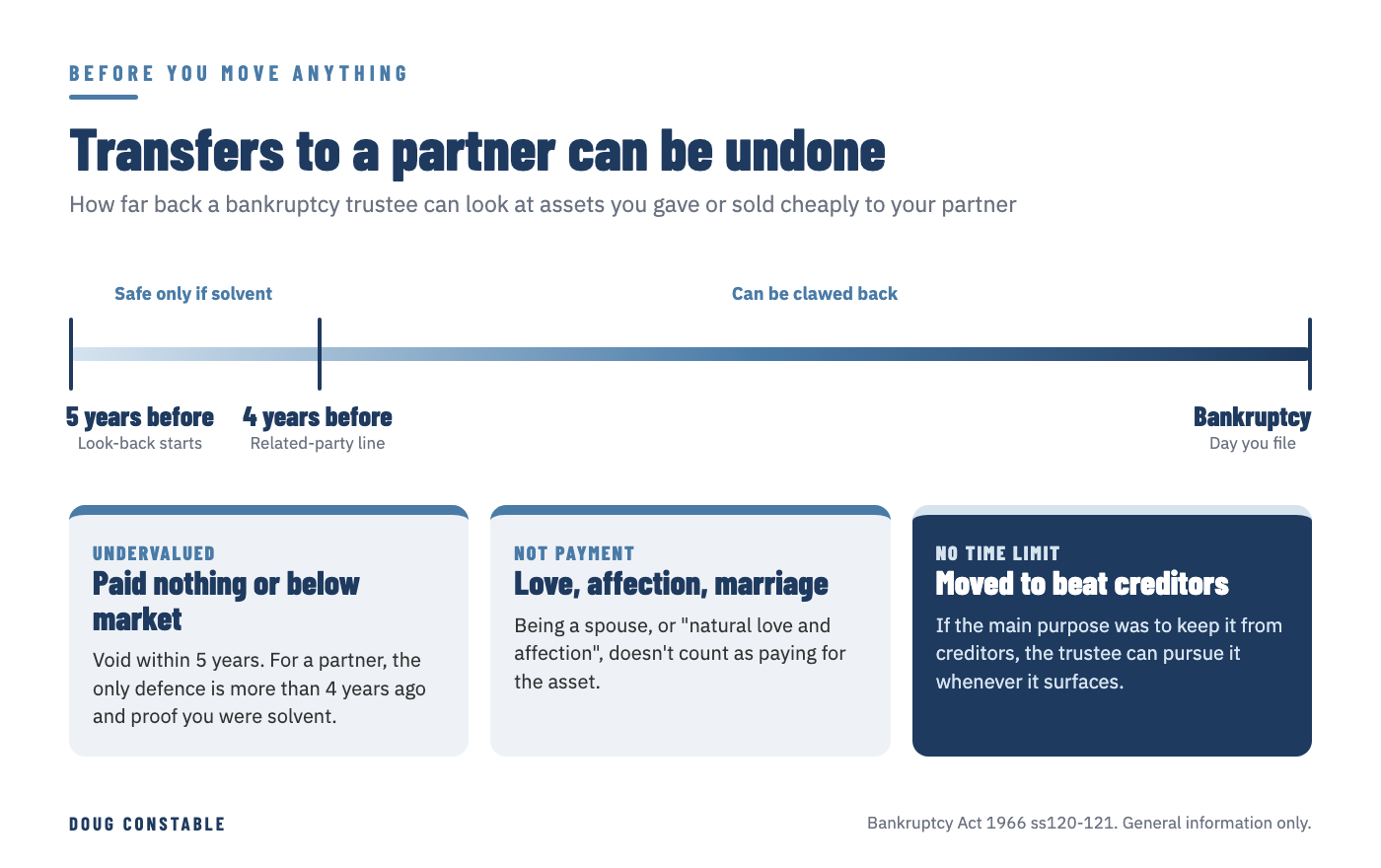
The law was written for exactly this. A trustee can look back five years and undo transfers where your partner paid nothing or less than market value. "Love and affection" doesn't count as payment, and neither does being married. A partner is a related party, so the only protection is if the transfer happened more than four years before the bankruptcy and your partner can prove you were solvent at the time and stayed that way. That's a hard thing to prove when the debts were already building.
If the main purpose of a transfer was to keep the asset away from creditors, there's no fixed time limit at all. The trustee can pursue it whenever it comes to light.
The result is worse than doing nothing: the asset comes back anyway, your partner ends up in a legal fight with a trustee, and your credibility in the bankruptcy is shot from day one.
Their income and your contributions
Your partner's income is not treated as yours, and they don't pay anything towards your bankruptcy. What their income does affect is the threshold used to work out whether you have to make income contributions. That threshold goes up for each dependant you support, and a partner only counts as a dependant if they live with you, rely on you financially and earn under a set annual amount. If your partner works full time, they generally won't count, and your threshold is lower.
That's not a penalty on your partner. It's worth knowing, because it changes the household budget for the three years of a bankruptcy.
Talk to your partner first
The financial side is manageable once you understand it. The part that does the real damage is the secrecy. I've watched people carry debt alone for a year or more because they couldn't face telling their partner, and by the time it came out, the options had narrowed and the trust had taken a hit as well.
In 1988 I lost my business, and I know how hard that conversation is. But your partner will find out. Far better they hear it from you, with a plan, than from a creditor's letter or a trustee's phone call.
Sit down together. Work out what's in whose name, what's joint and what's been guaranteed. Then get proper guidance before you sign anything or move anything. Most of the damage I see to partners comes from decisions made in a panic in the months before a bankruptcy, not from the bankruptcy itself.
- Speak directly to Doug: Get help
- Business recovery and restructuring: Resolve Business Solutions
- Independent bankruptcy help: Resolvency
- Read more insights
This article is general information, not legal or financial advice. Every household is different. Get guidance on your own situation before you act.
No robes. No wigs. Just results.