Restructure or Phoenix? Where the Legal Line Sits
By Doug Constable · 24 October 2026
There's a word that gets thrown at every director who closes one company and opens another: phoenix. Sometimes it's deserved. Often it isn't.
Starting again after a business fails is not illegal. It's how most successful operators I know got where they are. Plenty of good businesses are rescued through a proper process, keep their staff, and go on trading under new ownership or a new structure. That's restructuring, and the law encourages it.
What the law does not allow is moving the good bits out the back door for next to nothing, leaving the debts behind in an empty shell, and doing it all again. That's illegal phoenix activity. And since 2020, the rules have teeth.
What illegal phoenixing actually is
The ATO describes it as a company being deliberately liquidated, wound up or abandoned to avoid paying its debts, with a new company then carrying on the same business without them. The people left holding the bill are employees who lose wages and super, suppliers and subcontractors who don't get paid, and the tax system. A PwC study commissioned by the ATO, ASIC and the Fair Work Ombudsman put the direct cost at between $2.85 billion and $5.13 billion a year.
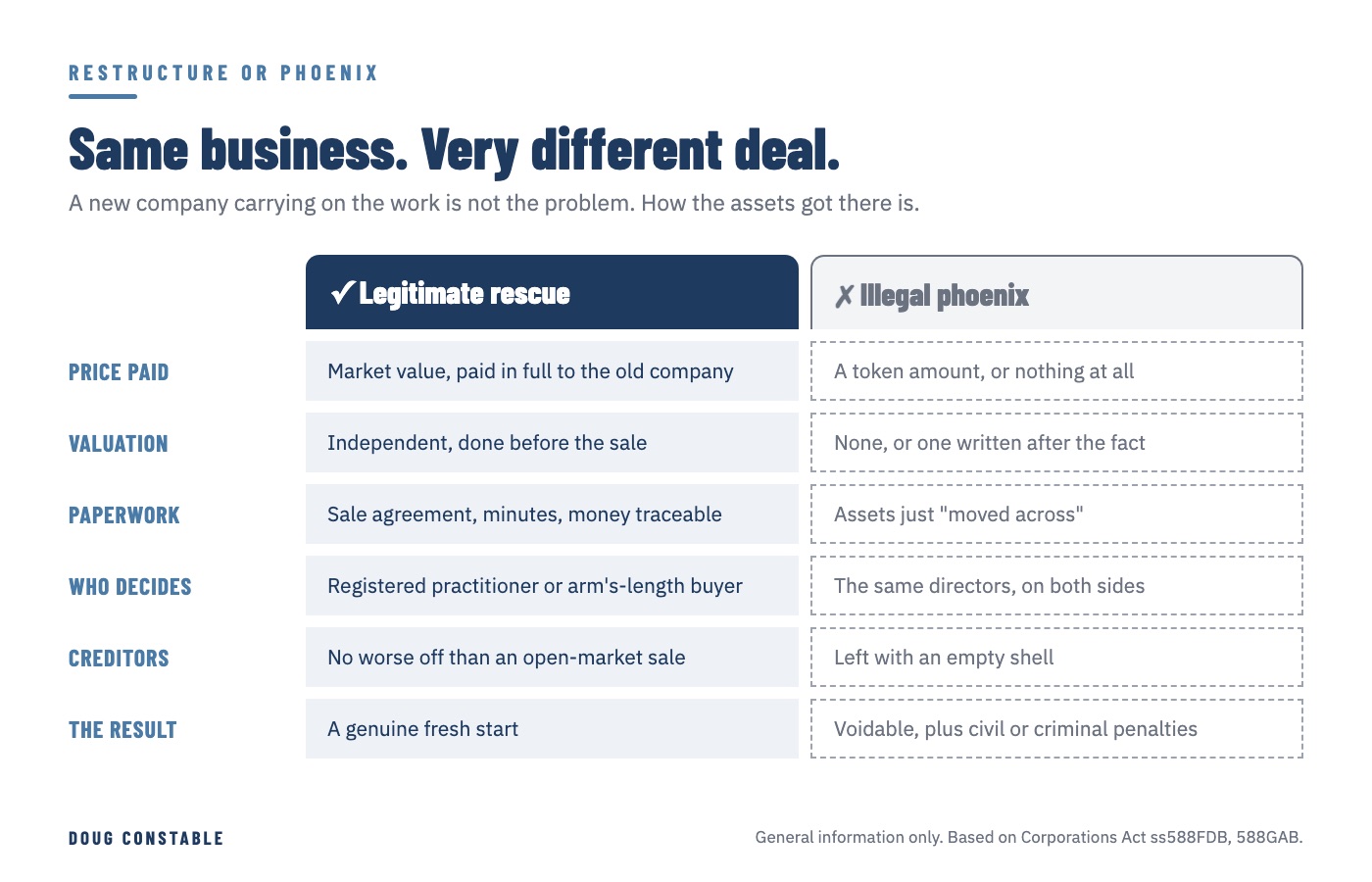
The tell is not that a new company exists. The tell is how the assets got there, and what was paid for them.
The 2020 laws: creditor-defeating dispositions
In February 2020 the government passed the Combating Illegal Phoenixing laws. The centrepiece is a concept called a creditor-defeating disposition.
Under section 588FDB of the Corporations Act, it's a disposal of company property where the company receives less than both the market value and the best price reasonably obtainable, and the disposal stops, hinders or significantly delays that property from reaching creditors. If it happens while the company is insolvent, causes the insolvency, or leads to an administration within 12 months, a liquidator can attack it.
Here's what that means in practice:
- The liquidator can get it back. They can apply to court to undo the deal, or ask ASIC to make orders directly. ASIC can order the asset returned, or the person who got it to pay back the benefit they received. No court case needed.
- Directors have a duty to stop it. Section 588GAB puts a duty on company officers to prevent creditor-defeating dispositions. Breach it and you face a civil penalty, or criminal charges if you were reckless.
- Advisers are on the hook too. Section 588GAC catches anyone who procures one. That includes the "pre-insolvency adviser" who sold you the scheme.
Legitimate processes are carved out. A sale by a liquidator, or under a deed of company arrangement or court-approved scheme, sits outside the duty. That's the point: do it through a proper process and you're protected. Do it on your own in the back room and you're not.
The other tools aimed at phoenix operators
The same reforms closed some old tricks. A director can no longer backdate a resignation by months to dodge liability; a resignation now takes effect when ASIC is told, unless it's lodged within 28 days. And directors can't all walk out and leave a company with nobody at the wheel.
Director penalty notices were extended to cover GST, luxury car tax and wine equalisation tax, on top of PAYG withholding and super. The ATO can also estimate GST that hasn't been lodged and chase directors personally for it.
Every director now needs a director ID, a unique number that stays with you for life across every company you run. It's built to let regulators trace a person through a chain of failed companies. Failing to have one is an offence ASIC enforces.
And sitting over all of it is the Phoenix Taskforce, around 39 federal, state and territory agencies, including the ATO, ASIC and the Fair Work Ombudsman, sharing data to find repeat operators.
How to restructure on the right side of the line
If your business is in trouble and you want to save what's worth saving, here's what a legitimate rescue looks like:
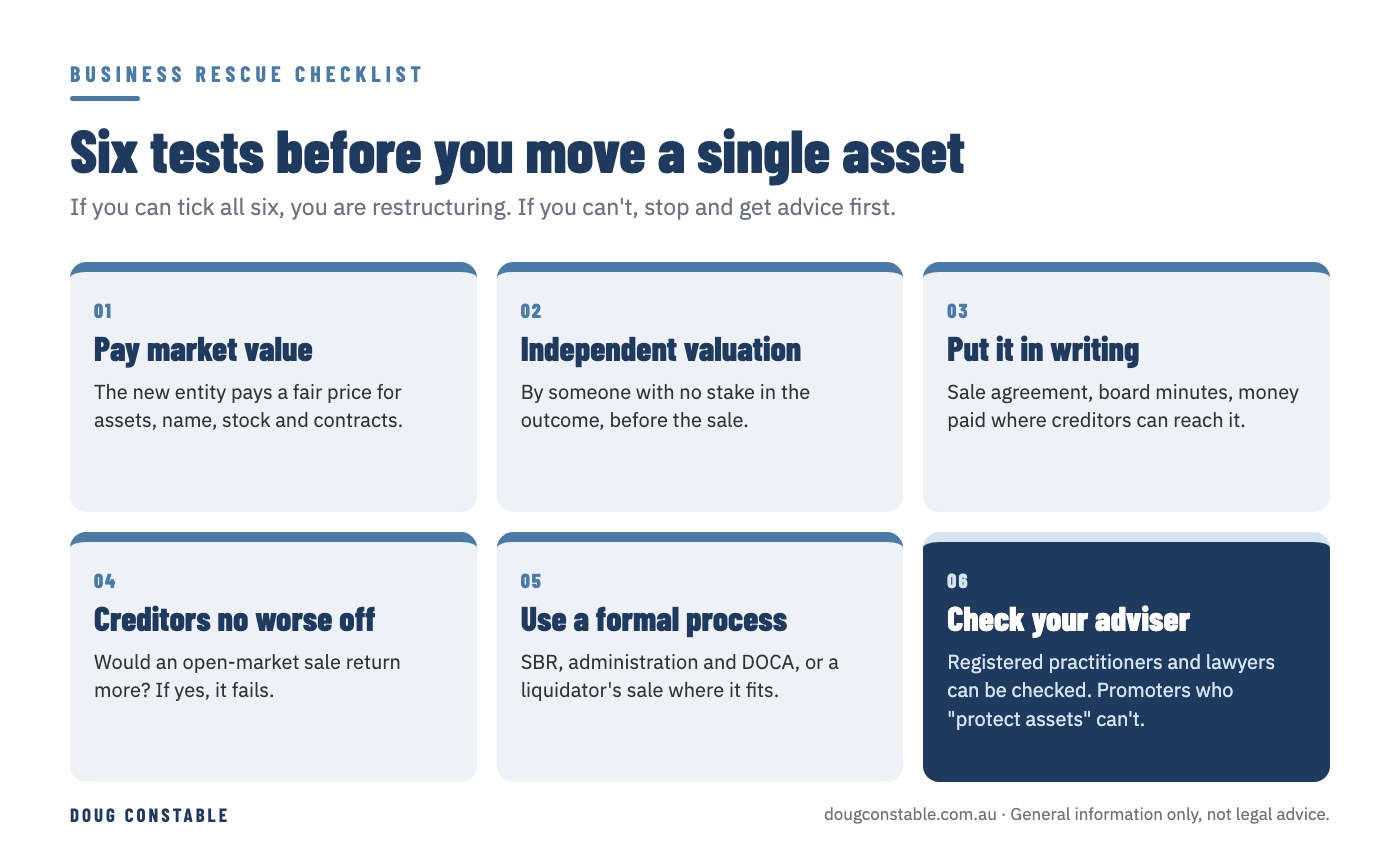
- Pay market value. If a new entity takes the assets, the business name, the stock or the contracts, it pays a fair price for them. Not a token dollar.
- Get an independent valuation. From someone with no stake in the outcome, done before the sale, not cobbled together after a liquidator starts asking.
- Put it in writing. A proper sale agreement, board minutes, and the money actually paid into the old company's account where creditors can reach it.
- Creditors are no worse off. The test is simple. Would creditors get more if the asset were sold on the open market? If yes, you've got a problem.
- Use a formal process where it fits. Small Business Restructuring, voluntary administration and a deed of company arrangement, or a sale by a liquidator all exist to rescue viable businesses. They put an independent registered practitioner in charge of the decisions that matter.
- Ask who's advising you. A registered liquidator or a lawyer can be checked. If someone offers to "protect your assets" before anyone else finds out, walk away. Under the 2020 laws, they're exposing you as well as themselves.
What I want directors to hear
I've spent 38 years helping people deal with failed businesses. Starting over is nothing to be ashamed of. Hiding what you owe is.
Directors who get into the worst trouble are usually not master criminals. They panicked, took bad advice, and moved assets without thinking about what a liquidator would see six months later. By then it's too late to fix.
If you're thinking about closing one company and starting another, have that conversation before you move anything. Done properly, it's a fresh start. Done badly, it follows you personally for years.
- Speak directly to Doug: Get help
- Business recovery, SBR and liquidation: Resolve Business Solutions
- Independent bankruptcy help: Resolvency
- Read more insights
This article is general information only. It is not legal or financial advice. Get advice on your own circumstances from a registered insolvency practitioner or lawyer.
No robes. No wigs. Just results.